


AI Governance in Credit Processes
AI Governance in Credit Processes
The true value of artificial intelligence in credit processes lies in more than just faster decision-making. The real value is the ability to maintain control, explainability, and the institution's risk management approach while simultaneously reducing decision times.
Is rapid decision-making sufficient on its own?
Digital channels have transformed credit applications into an experience lasting just a few minutes. While customers expect their applications to be processed as quickly as possible, financial institutions monitor decision times as key indicators of both customer experience and operational efficiency. AI-powered document analysis, automated scoring, and credit decision engines offer significant capabilities to meet this expectation. However, the quality of a credit decision cannot be measured solely by the number of seconds it takes to reach it.
Decisions must be made for the right customer, with appropriate limits and terms, and in alignment with the institution's credit policy. Furthermore, it must be possible to explain the data, rules, and controls upon which the decision was based.
“The rationale behind a credit decision made in seconds must be demonstrated with equal clarity.”
The cost of a decision that is rapid but lacks a demonstrable rationale may manifest later as a delinquent receivable, an audit finding, a lost customer, or a customer dispute. This is precisely where AI governance becomes crucial.
What does AI governance mean in the context of credit processes?
AI governance is sometimes viewed solely through the lens of model accuracy and regulatory compliance. While both are important, governance in credit processes encompasses a much broader scope. Indeed, the European Union AI Act classifies AI systems used to assess the creditworthiness of natural persons or to generate credit scores—subject to certain exceptions—as high-risk applications.
For financial institutions, the core issue lies in how the chain extending from the data source to the credit decision is managed. What data does the model use? Is the data source reliable and up-to-date? Is the model's output translated directly into a decision, or is it evaluated alongside rules that reflect the institution's credit policy? Under what circumstances is expert review required? Who approves changes to models and rules? If a decision is reviewed months later, is it possible to reconstruct the data, model version, and rules used at that time?
These are not questions for the IT department alone to answer. Credit origination, risk management, operations, compliance, internal control, and technology teams are all responsible for different segments of this same decision-making chain. Governance ensures that this entire chain remains visible and manageable from start to finish.
Key elements of controlled AI
Controlled AI is not merely about the performance of a single model. A robust credit decisioning process requires the integration of reliable data, clear business rules, human oversight at the right stage, explainability, and continuous monitoring. This framework balances the speed of AI with corporate control and auditability.
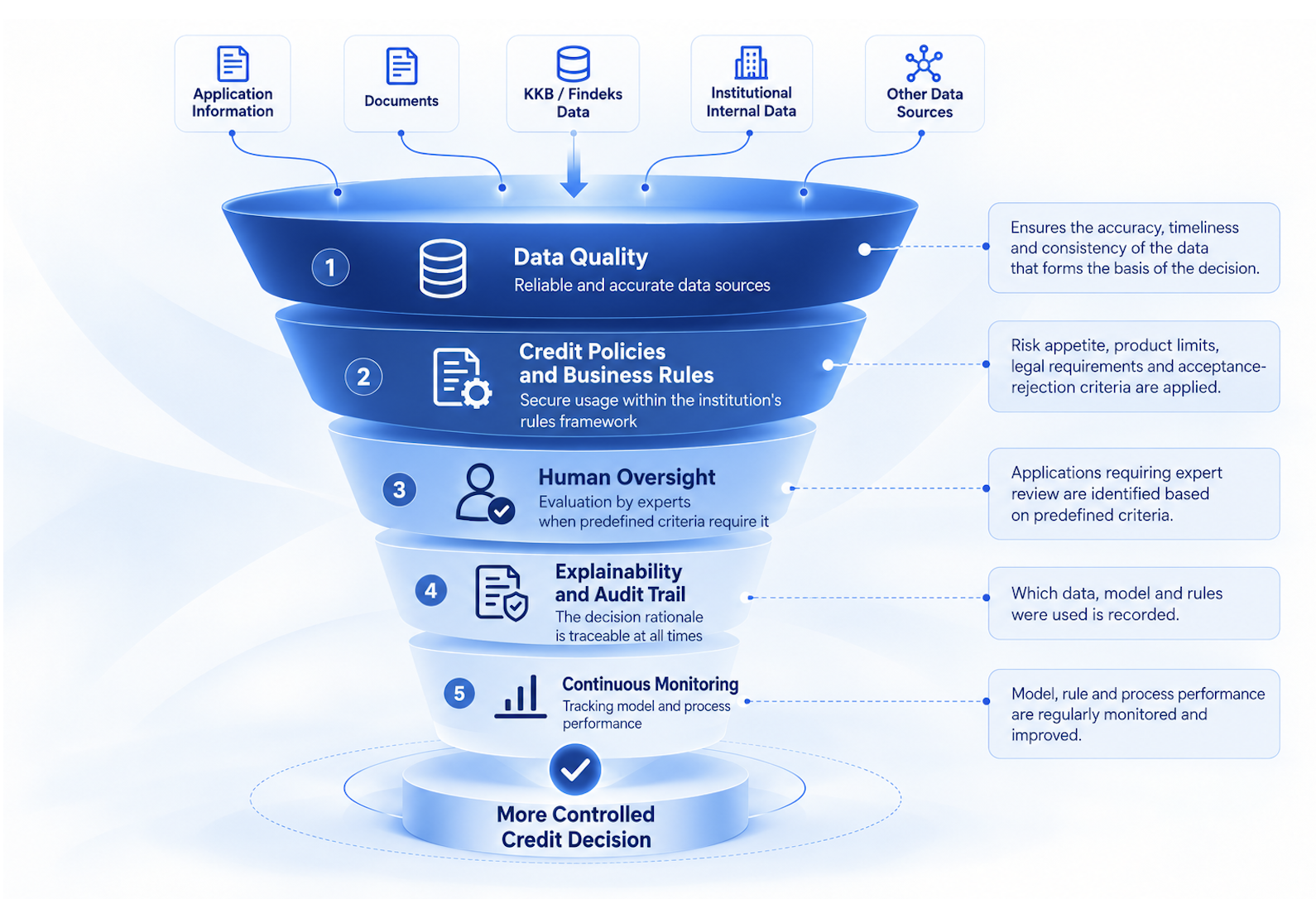
The first issue to address is the data itself. The output of an AI model cannot be considered independently of the reliability of the data it utilizes. Data that is incomplete, outdated, or contradictory across different sources affects not only model performance but also the quality of the credit decision. Therefore, it is essential to know the source, acquisition time, and validation checks applied to the critical data used in the decision-making process.
The second element is credit policy. An institution's risk appetite, product limits, legal obligations, and binding acceptance/rejection criteria must be governed by clear rules. The role of AI should not be to replace credit policy, but rather to generate new data, signals, and insights that can be utilized within that policy framework.
The third element is human oversight. The objective here is not to have an expert re-examine every AI output, but to pre-determine the conditions under which human intervention is required. This allows credit specialists to focus on exceptions that genuinely require assessment, rather than re-reviewing routine applications.
The fourth element is explainability and the audit trail. Understanding how a score is generated is important, yet insufficient for credit processes. It must be possible to reconstruct the entire decision when necessary: which documents were used, what external data was retrieved, which model version was executed, which rules were triggered, and—if human approval was required—who granted it?
The final element is continuous monitoring. A model that yields successful results upon deployment may not maintain the same performance as customer profiles, economic conditions, or the types of documents used evolve over time. In addition to model performance, process indicators—such as applications routed for manual review, the rates at which experts override model recommendations, and post-approval credit performance—must also be monitored.
Decision tree or artificial intelligence?
Rule-based credit decision engines and artificial intelligence are sometimes considered as alternatives to each other. However, there are different things that the two structures do better.
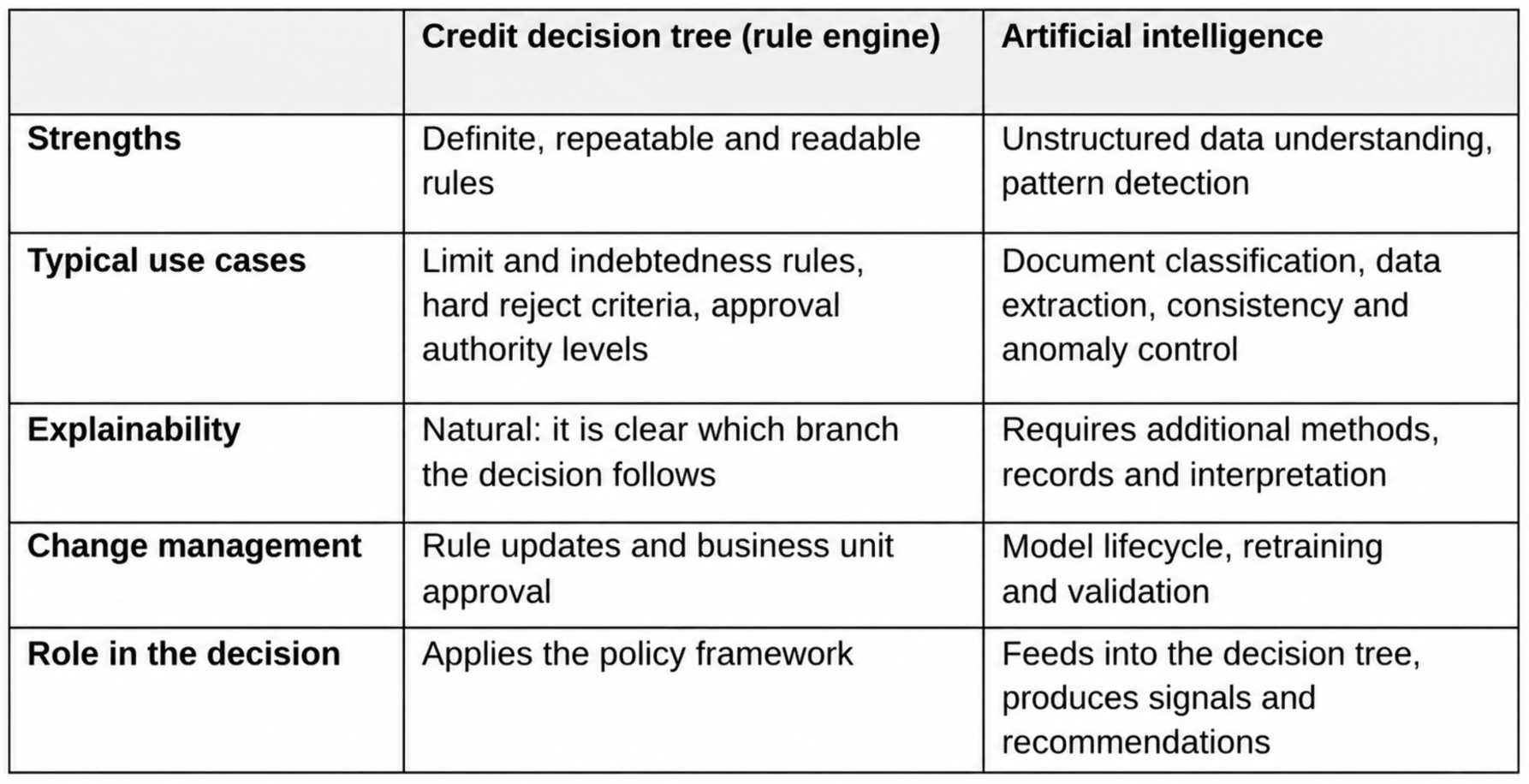
A decision tree applies indebtedness thresholds, product limits, acceptance/rejection criteria, authorization levels, and other credit policy rules in a clear and repeatable manner. Artificial intelligence, on the other hand, can support the decision-making process in areas such as deriving meaning from unstructured data, document classification, data extraction, inconsistency detection, and flagging anomalous patterns.
For instance, an amount extracted from proof-of-income documentation or a confidence score generated through document analysis does not necessarily have to translate directly into a credit decision. Instead, this information can be fed into the decision tree as a variable and evaluated within the framework of the institution's credit policy. Consequently, the model output becomes one of the traceable inputs for the decision, rather than the decision itself.
Set Yazılım’s Credit Assessment and Decision Tree infrastructure enables the management of dynamic datasets, scoring models, and rule-based decisions within a unified framework. The ability to expand the data structure over time facilitates the controlled integration of new signals—generated by AI applications—into the decision-making process.
Document analysis: An area where AI excels
Credit applications involve the evaluation of a wide variety of documents, such as identity and address details, proof of income, tax records, utility bills, financial statements, and signature circulars. Moreover, these documents do not always arrive in the same format or quality. Consequently, document analysis is one of the areas where AI can make a tangible contribution to credit processes.
Set Yazılım is also working on AI-powered document verification for credit applications as part of an R&D project approved by Düzce Technopark. The system under development aims to support processes such as identifying the type of uploaded document, structuring the relevant data, and cross-referencing this information with the application declaration, other documents, or various data sources. There is an important distinction to be made here:
“The fact that AI can extract information from a document does not mean that the information has been verified.”
The confidence level of the model's output must be evaluated in conjunction with other data sources and the institution's business rules. If there is a low confidence score, an inconsistency between documents, or an anomaly requiring assessment, routing the application for expert review ensures a more controlled approach.
We previously covered the technical aspects of this topic in detail in our article titled “AI-Powered Document Verification in Credit Application Processes.”
From a governance perspective, it is crucial not to view document analysis merely as a preliminary check independent of the credit decision. Findings derived from documents should be integrated into the decision-making process and recorded in a manner that allows for future review if necessary.
External data is also part of the decision-making process.
In addition to internal data, information obtained from external sources such as KKB and Findeks is utilized during credit assessment. Factors such as credit scores, limits, risk data, delinquency history, and records of outstanding debts contribute to the decision-making process.
The governance aspect here goes beyond mere data access; it involves using the right data at the right time by linking it to the specific application.
Manually reading data from one system and transferring it to another can increase the risk of error. Likewise, it is crucial to determine whether previously obtained data remains current for a new credit decision. Relying solely on external data, however, risks overlooking a customer's internal history or insights derived from application documents.
Set Yazılım’s Findeks Automation solution facilitates the automatic transfer of KKB and Findeks data into the credit assessment process. Data retrieved through individual, batch, or periodic queries is evaluated against predefined rules and utilized within the credit workflow. This has a significant implication for governance: the model, the decision tree, and the credit specialist can all work with the same dataset, and the specific external data used can be identified during subsequent reviews of the decision.
Where should human intervention occur?
In a human-in-the-loop AI approach, it is necessary to avoid both extremes. Subjecting every application to human approval largely negates the efficiency gains offered by automation. Conversely, bypassing human review entirely can create control issues, particularly in exceptional or high-risk cases.
However, before discussing where human oversight should intervene, one must address a more fundamental issue: how is AI positioned within the architecture of the credit process?
Viewing AI merely as a separate technology layer grafted onto specific points of an existing system may fail to deliver the expected transformation. Reading a document via AI, generating a score using a machine learning model, or automating a specific check does not, in itself, constitute an AI-driven transformation of the credit process.
The real need is to design the entire credit lifecycle—from start to finish—to be compatible with AI. This does not imply that AI must be used at every operational step. Aspects such as data collection and transfer between systems, the integration of AI outputs into the decision engine, exception management, and outcome monitoring should all be considered components of a unified architecture.
Otherwise, a process accelerated by AI could turn into a new bottleneck due to manual checks at a subsequent stage. If document analysis is completed in seconds but the output requires manual transfer to another system, or if an AI-generated assessment is repeatedly sent for human approval, a significant portion of the speed advantage provided by the technology is lost.
A similar issue can arise regarding governance and human oversight. When there is insufficient understanding of how the AI operates, the confidence level of its outputs, and the circumstances under which the risk of error increases, institutions may act cautiously and establish excessive control points. In such cases, human oversight ceases to be a risk management tool and instead becomes a new bottleneck in the process. Consequently, the gains in speed, operational efficiency, and accuracy targeted through the AI investment fail to fully materialize.
Therefore, human intervention should be triggered based on predefined conditions that take into account the institution's credit policy, risk appetite, and the performance characteristics of the AI model in use. Examples include:
- the AI-generated confidence level falling below a specified threshold,
- inconsistencies between the application declaration, submitted documents, and external data,
- encountering a situation not anticipated by the decision tree,
- observing unusual patterns in the application or documents,
- the loan amount or risk level exceeding established authorization limits.
When any of these conditions arise, the application can be referred to the appropriate personnel, accompanied by information explaining why expert review was required. Thus, human oversight transforms from a generic approval step repeated at the end of every transaction into a targeted control mechanism that engages only when truly necessary.
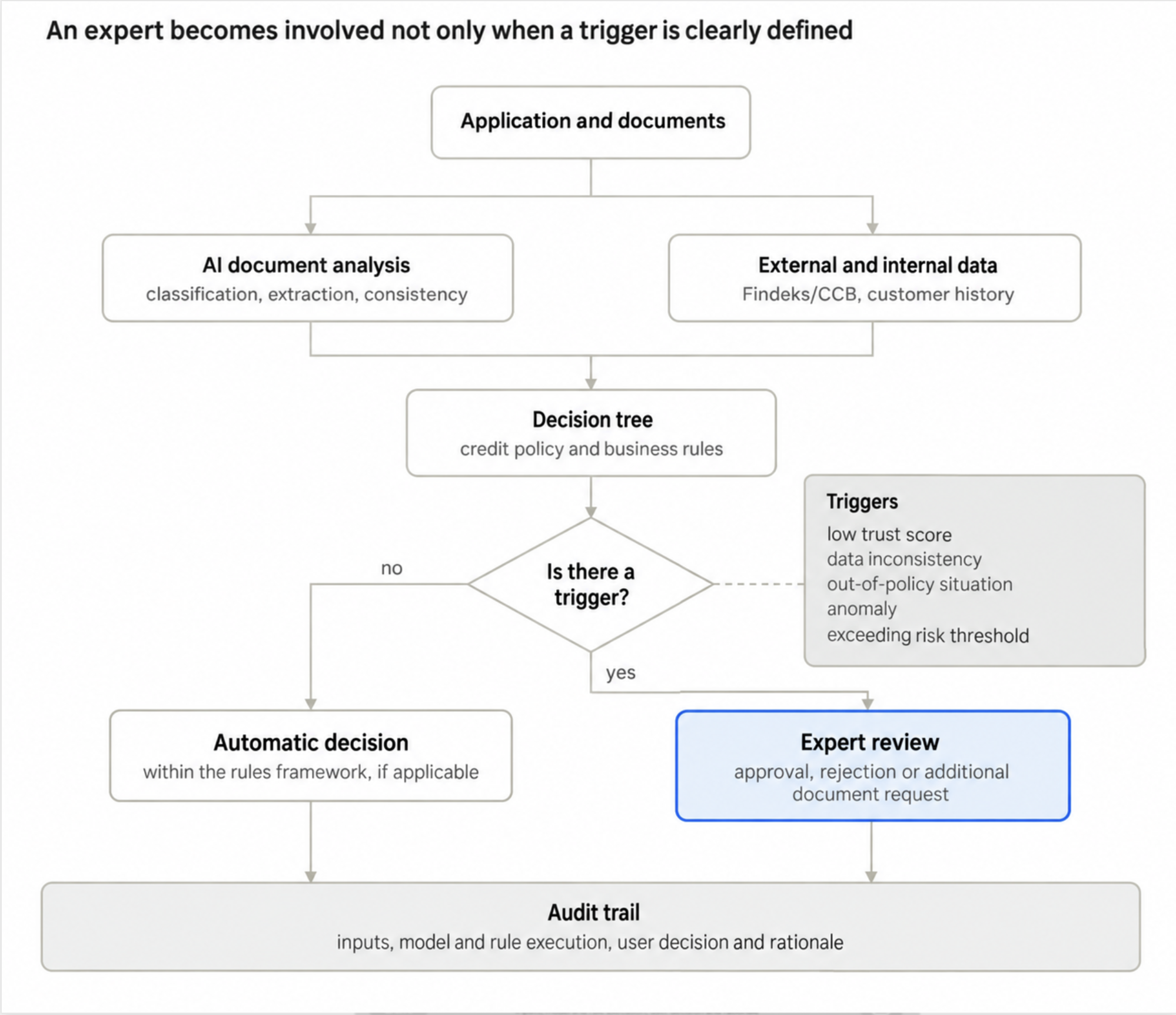
It is also important to keep a record of the expert's decision and the rationale behind it. These records not only strengthen the audit trail but also facilitate the periodic re-evaluation of models, rules, and confidence thresholds. In this way, human intervention ceases to be an alternative to artificial intelligence and instead becomes a feedback mechanism that contributes to the system's learning and development.
The fundamental principle of this approach is simple: rather than merely adding artificial intelligence to the existing credit process, the process itself is redesigned in conjunction with artificial intelligence.
End-to-end governance, not just model management
Treating AI governance solely as the management of the model itself is insufficient. If an application resides in one system, documents in another application, external data on a separate screen, and expert assessments in email or a standalone app, it becomes difficult to gain a holistic view of the credit decision later on.
A controlled framework must extend governance across the entire credit lifecycle.
Set Yazılım’s CFS Credit Financing Solution handles various stages of the credit lifecycle—from application and sales channels to evaluation and allocation, and from document management to post-credit processes—within a unified framework. Integrations with KKB, the Risk Center, the Trade Registry, and banking systems also enable the incorporation of external data into the credit process.
Thanks to its modular structure, AI components can be positioned as integral parts of the relevant credit process rather than as standalone applications.
When document verification results, Findeks data, decision tree rules, and—where necessary—expert judgments all become traceable components of the same application, AI governance ceases to be a theoretical concept and transforms into an integral part of daily operations.
What questions should be asked when transitioning from a pilot to a production environment?
The success of an AI application in a pilot involving limited data and users is a significant starting point. The real test begins when the solution is integrated into actual credit operations.
Before moving to production, the organization needs to establish a common approach regarding at least the following issues:
- Which decisions will the AI support, and which will remain subject to rules or human oversight?
- How will the ownership, currency, and quality controls of the internal and external data to be used be managed?
- In which situations will human review be mandatory?
- How will the model output be explained to the credit specialist, internal audit, and—where necessary—the customer?
- Who will test and approve changes to models, rules, and thresholds?
- Which indicators will be used to monitor performance, and how can the process safely revert to rule-based or manual operations if the model behaves unexpectedly.
It is not possible for a single unit to answer all these questions. Technology, credit underwriting, risk, compliance, and internal control teams need to work within a shared framework.
From rapid decision-making to controlled decision-making
While artificial intelligence brings speed and scale to credit processes, it also enables the use of data types that were previously difficult to process within decision-making workflows.
However, speed alone cannot be the sole objective.
The future of credit processes is moving toward redefining the human role rather than completely removing humans from the decision-making mechanism. While credit specialists focus on exceptions, credit policy, and complex assessments instead of routine checks, decision trees implement credit policy, and artificial intelligence supports the decision process in areas such as document analysis, consistency checks, and pattern detection.
The key differentiator in credit technologies is not simply using artificial intelligence at every possible point, but rather integrating it with reliable data, transparent business rules, human expertise, and auditable processes.
You can contact Set Yazılım experts to evaluate how artificial intelligence, decision trees, and data integrations can work together in a controlled manner within your credit decision processes.
Frequently Asked Questions
What is AI governance in credit processes?
It involves defining the data, rules, control mechanisms, and authorities used—from the data source to the final decision—within a credit process that utilizes artificial intelligence. While model accuracy and regulatory compliance are key components, governance extends beyond these aspects.
Does AI replace the credit decision tree?
Not always. Clear and binding rules regarding credit policy can be managed via decision trees. AI, however, can provide additional information and signals to the decision engine in areas such as document analysis, data extraction, consistency checks, and anomaly detection.
Does AI eliminate human oversight in credit processes?
That is not the objective. A more controlled approach involves pre-determining the points where human review intervenes—such as in cases of low confidence levels, data inconsistencies, deviations from policy, or when specific risk thresholds are met.
Why is explainability important in credit processes?
It must be possible to review a credit decision when necessary. A more robust structure—for both internal control and auditing purposes—is established when there is visibility into the data and documents used, the models and rules applied, and the nature of any human intervention.
Is AI-powered document verification sufficient on its own?
No. The results of document analysis must be evaluated in conjunction with other data sources, credit policies, and decision-making mechanisms. AI-generated output should not be viewed in isolation as a verified fact or a final credit decision.